-
By akashhasija20@gmail.com
-
August 26, 2026
- 0 Comment
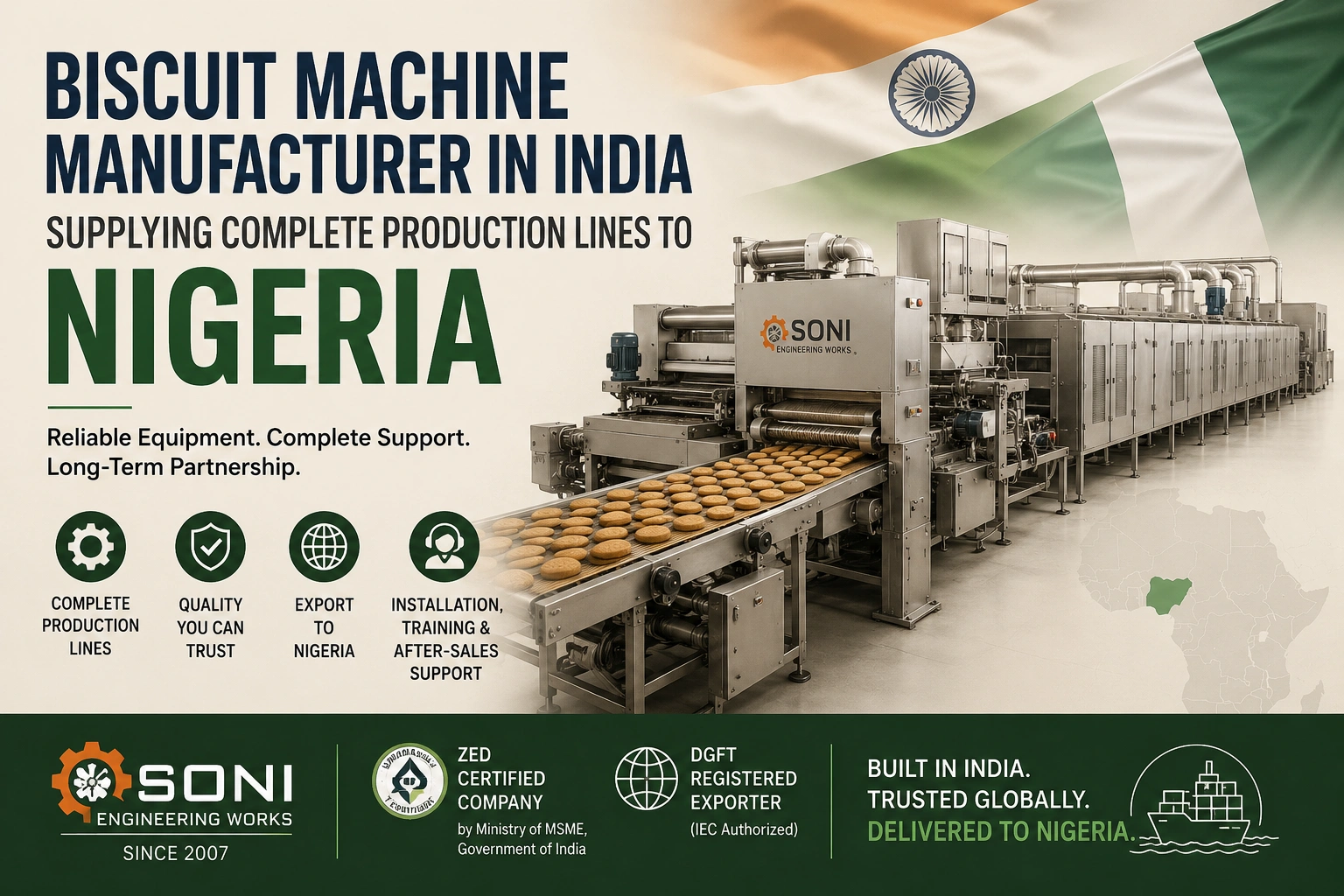
Biscuit Machine Manufacturer in India Supplying Complete Production Lines to Nigeria
Many equipment inquiries from Nigeria start the same way. A buyer has land. They have capital. They know what biscuit they want to produce. What they don’t have is a supplier who’ll still answer the phone months after the machines arrive.
That’s the gap Soni Engineering Works was built to close.
Since 2007, Soni Engineering Works has manufactured biscuit production equipment from MIDC Ambernath, Maharashtra, and supplied complete production lines to buyers in India and across international markets, including Nigeria.
Our company holds ZED certification from the Government of India’s MSME Ministry and a valid import-export code under the DGFT. Both matter to an international buyer. “ZED” means the manufacturing process has been independently assessed against national quality standards – not self-certified. The DGFT registration means documentation, customs classification, and cross-border shipment compliance are handled inside a regulated framework, not improvised per order.
For a Nigerian manufacturer evaluating a biscuit machine manufacturer in India, those credentials answer the first question: Is this supplier operating within a verifiable system, or outside one?
What the Supply Actually Covers
A single machine doesn’t produce biscuits. A calibrated sequence does: dough preparation, forming, baking, cooling, stacking, and packaging, with each stage matched to the one before and after it. Soni Engineering Works supplies complete lines, instead of individual machines dropped into a buyer’s facility and left to integrate.
The equipment range covers both product categories.
- Soft dough varieties – cookies, cream biscuits, and glucose types – are formed on the rotary moulder.
- Hard dough varieties – Marie, crackers, and hard-sweet biscuits – are sheeted, laminated, and cut on the rotary cutter.
Both lines run in a fully automatic configuration for commercial-scale output or a semi-automatic configuration for smaller-volume operations and premium short-run products.
Working widths run from 600mm to 2000mm. The right width depends on these things: daily production target, available floor space, and anticipated growth. A 600mm line produces a lower biscuit count per oven pass. A wider line produces more, but the capital requirement and floor footprint increase proportionally. We help buyers work through that calculation before any equipment is specified.
Why Indian Manufacturing Makes Sense for Nigerian Buyers
India’s biscuit equipment manufacturing sector produces machinery to the same output standards as European alternatives – at capital costs that make commercial-scale production viable for first-time plant owners, not just established manufacturers. A buyer entering the Nigerian market with a 2,000kg/day target doesn’t need a European line at three times the price. They need a line that performs to specification, is supported post-installation, and can be expanded when demand justifies it.
That’s the practical case for sourcing from a biscuit plant manufacturer in India.
The Export Model
- International projects include consulting, factory layout planning, installation, and on-site production management through the first production cycles.
- Operators are trained before the team leaves the site.
- Documentation is supplied for independent operation afterward. The full scope is confirmed at the consultation stage.
Frequently Asked Questions
Does Soni Engineering Works supply to Nigeria specifically?
The company is a registered exporter under India’s DGFT framework and has supplied equipment to international buyers. Nigeria-based inquiries follow the same export process as other international projects – consultation, layout, equipment, installation, and commissioning.
What’s the minimum viable plant size for a new Nigerian biscuit manufacturer?
That depends on the daily production target and available capital. A semi-automatic plant with a 600mm working width is the lowest-cost entry point. The right starting configuration is confirmed through the initial consultation, where production targets and floor space are factored in before any line is specified.
How is after-sales support handled for international buyers?
Operator training and production documentation are completed on-site before the Soni Engineering team leaves. For equipment queries after that, contact is direct – with the team that built the machines.