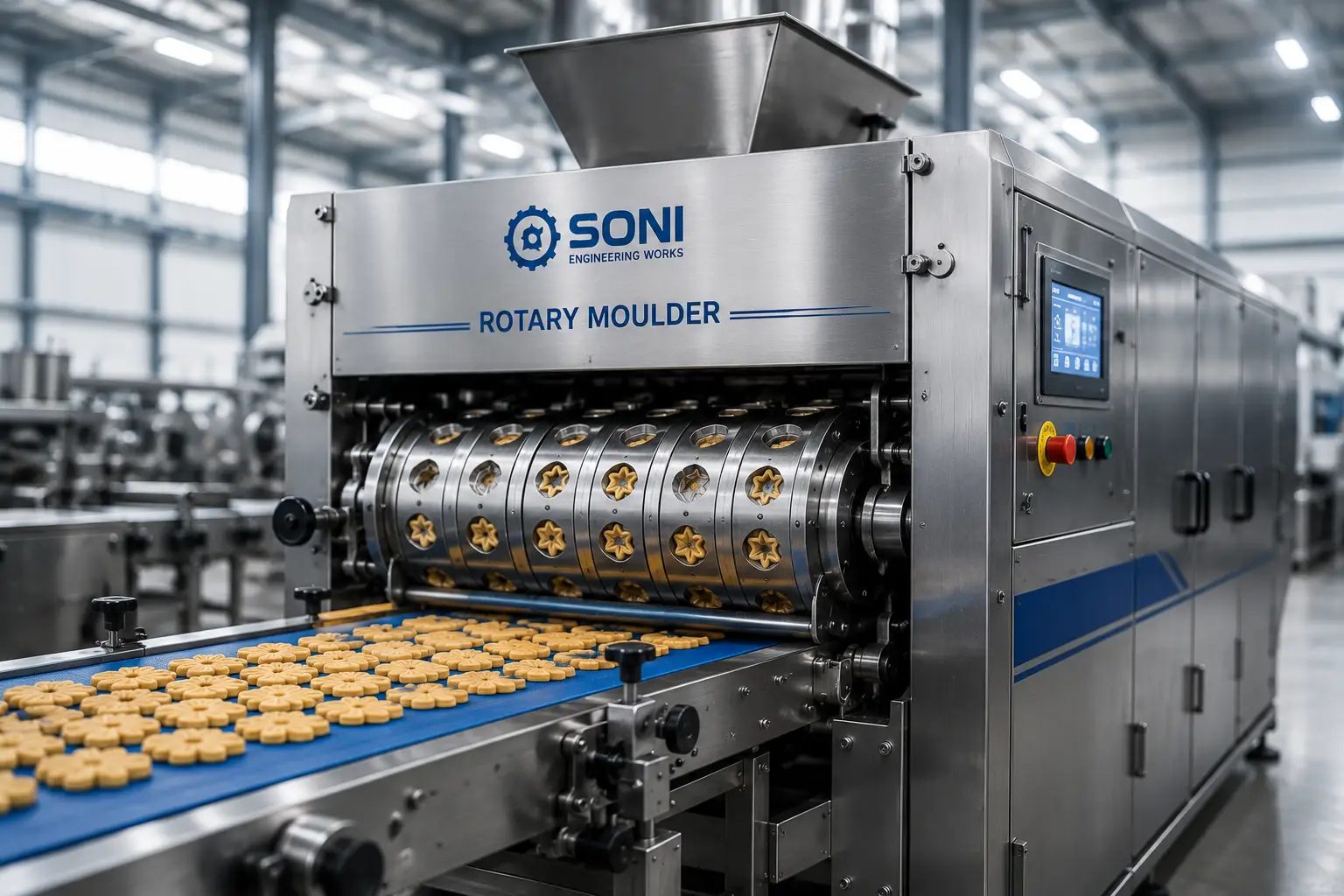
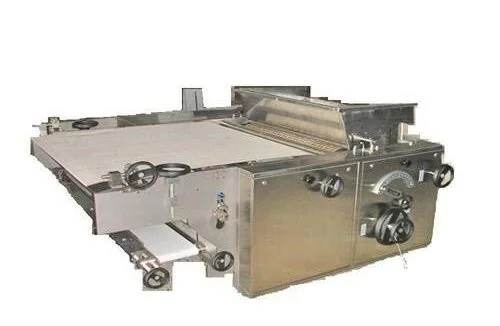
Soft dough tears under a sheet. That’s not fixable by adjusting pressure or speed. The physics of high-fat, low-gluten dough won’t cooperate with the sheeting process. The rotary moulder exists because of that exact problem. The machine addresses it mechanically. A feed roller forces dough into the engraved cavities of the moulding roller. A knife scrapes the surface clean. Then a food-grade rubber roller presses a cotton web against the moulding roller. Shaped pieces transfer onto that web and move directly toward the oven. No sheeting step. No tearing. The feed roller isn’t just a delivery mechanism. Its speed sets dough density inside each cavity. Too fast and the fill is loose. Too slow and it overpacks. The moulding roller, gear-driven from the feed roller, holds the engraved biscuit pattern. The rubber roller completes the transfer. All three drives interact. A mismatch between any two shows up as inconsistent biscuit weight before it shows up as anything visible. Some buyers ask whether a depositor could handle soft dough instead. For high-fat drop cookies, it can. But a depositor can’t replicate the surface definition a moulding roller achieves. The clean edge, the embossed pattern, the consistent cavity fill — none of those come from a depositor. For varieties where surface definition matters, a depositor gives you a different product. Not a worse one, necessarily. A different one. Soni Engineering Works builds the Rotary Moulder for 60″ wide production lines. Moulding roller: 10.2″ dia. (400 mm). Feed roller: 9.4″ dia. Rubber roller: 9.5″ dia, food-grade rubber-coated. Power: 280–415V, 50Hz. Body: mirror finish. Separate drive configuration available on request. One fact buyers consistently miss: the moulding roller is not in the standard scope of supply. It’s ordered separately, engraved to the buyer’s specific biscuit shape, cavity count, and surface design. The machine ships without it.
Frequently Asked Questions
01. What dough types work with the Rotary Moulder?
Soft dough only — high-fat, extensible varieties that tear under a sheeter. Hard dough biscuits need a rotary cutter. The two forming methods aren’t interchangeable.
02. Is the moulding roller included with the machine?
separately, engraved to the buyer’s required biscuit shape and cavity count. The machine and roller are matched but supplied independently.
03. What are the technical specifications?
280–415V, 50Hz, 60″ wide line configuration. Moulding roller: 10.2″ dia. (400 mm). Feed roller: 9.4″ dia. Rubber roller: 9.5″ dia., food-grade coated. Mirror finish body. Separate drive available on request.