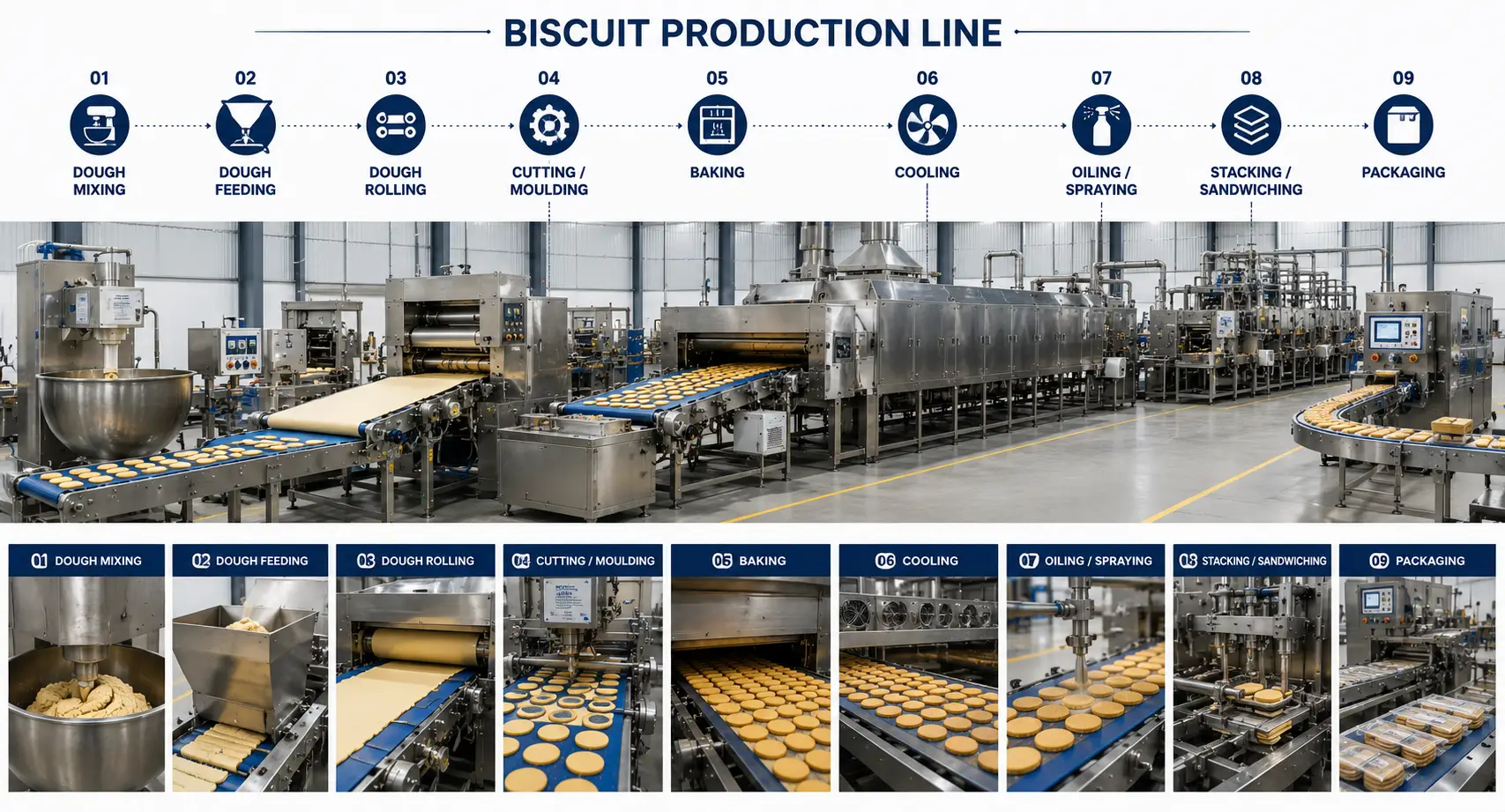
A biscuit production line isn’t a machine. It’s a sequence, and what breaks in most plants isn’t any individual piece of equipment. It’s the gap between one stage and the next, where an integration decision was made without accounting for what the downstream stage needed from the one before it. Soni Engineering Works has manufactured biscuit production lines for buyers across India and internationally for over three decades. The most consistent pattern across new inquiries: buyers arrive with a machine question when the answer they need starts at the system level. The system question comes first. What product is being made? At what daily volume? With what team running the line across how many shifts? Those answers determine whether the configuration should be semi-automatic or fully automatic, whether the forming stage needs a rotary mold or a rotary cutter, and how the baking, cooling, and packing stages need to connect. Settle the system question first. The machine selection follows from it, not the other way around. Where lines fail isn’t always obvious at the point of purchase. A forming stage rated for a certain throughput, paired with a cooling section specified for a lower one, creates a bottleneck that presents as an underperforming line rather than a mismatched specification. Soni Engineering Works supplies complete lines precisely to close that gap, so the rated output of each stage is matched to the stages it feeds and receives from. Semi-automatic and fully automatic configurations are both available, covering soft dough and hard dough varieties. A regional bakery entering production for the first time and an established manufacturer scaling output for an export order don’t need the same answer. Both need one that’s been worked out at the system level before any equipment ships.
Frequently Asked Questions
01. What does a complete biscuit production line include?
A full line covers the forming stage (rotary molding for soft dough, rotary cutting for hard dough), baking, cooling, stacking, and packing. Soni Engineering Works supplies complete lines in both semi-automatic and fully automatic configurations.
02. How is the right biscuit production line configuration determined?
By production volume, floor space, shift structure, and capital position – assessed before any equipment recommendation is made. The line specification follows from the production requirement, not from a catalog.
03. Can Soni Engineering Works supply a single machine rather than a complete line?
Yes. Individual machines, forming, baking, cooling, stacking, or packing – are available as standalone equipment. A complete line is the right scope when the full production sequence is being set up or overhauled.