
-
By akashhasija20@gmail.com
-
September 2, 2026
- 0 Comment
Biscuit Plant Manufacturer in India for DRC
Kinshasa is one of Africa’s fastest-growing cities, with a metropolitan population now among the largest on the continent, and it sits within a country whose sheer size — the Democratic Republic of Congo (DRC) spans roughly the area of Western Europe — makes internal logistics as important a planning factor as the initial import itself. For a biscuit manufacturer, this scale represents both a genuinely large addressable urban market and a practical challenge: getting equipment to site depends heavily on which part of the country a plant will serve. Soni Engineering Works, a biscuit plant manufacturer in India, supplies biscuit production machinery and complete plant solutions to manufacturers, food-processing businesses, investors and distributors evaluating production in the DRC.
Choosing an Import Route That Matches Your Plant’s Location
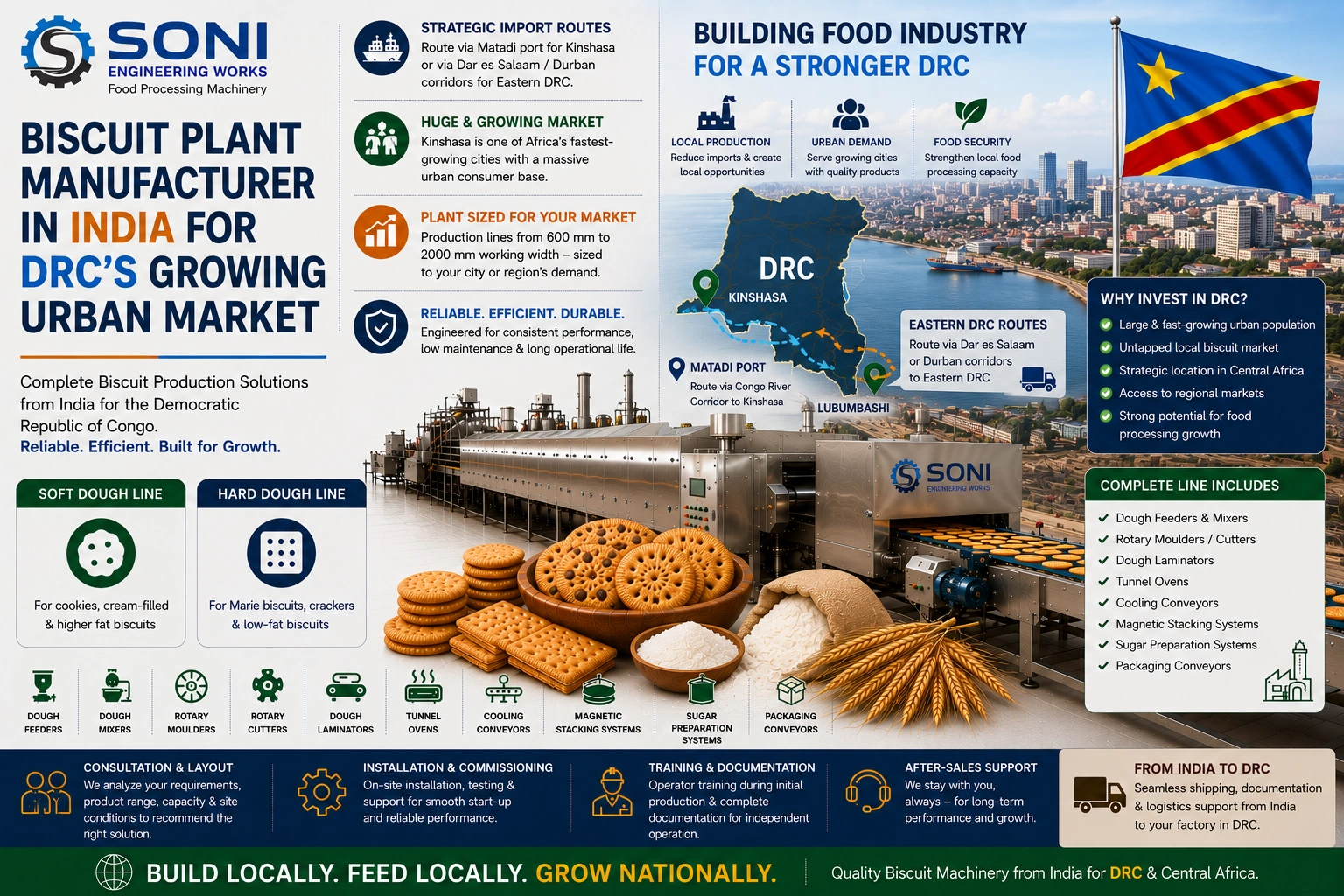
A plant based in or near Kinshasa typically receives equipment via the port of Matadi, on the DRC’s short Atlantic coastline, followed by transport up the Congo River corridor. A plant in the eastern DRC — around Lubumbashi and the copper-mining Katanga region, for example — is often better served through the Dar es Salaam or Durban corridors instead, given the distances involved from Matadi. This choice of routing is discussed with each buyer early in the process, since it affects both shipping timelines and total landed cost. As a biscuit machine manufacturer in India, Soni Engineering Works offers production lines with working widths from 600 mm to 2000 mm, allowing a plant to be sized around confirmed demand in its specific target city or region rather than the country as a whole.
Soft Dough and Hard Dough Lines
Machinery configuration depends on the biscuit type:
- Soft Dough Lines — for higher-fat, higher-sugar biscuits such as cookies and cream-filled varieties, formed with a rotary moulder.
- Hard Dough Lines — for lower-fat, gluten-developed dough that is rolled, laminated and shaped with a rotary cutter, used for Marie-style biscuits and cracker-type products.
Soni Engineering Works reviews the intended product range and target city with each buyer before recommending a line, since the two dough types are processed on different equipment settings.
Complete Machinery and Line Components
The equipment range covers the full biscuit production sequence — dough feeders, dough mixers, rotary moulders, rotary cutters, dough laminators, tunnel ovens, cooling conveyors, magnetic stacking systems, sugar preparation systems and packaging conveyors — supplied as standalone machines for buyers upgrading an existing line, or as a complete integrated plant for a new facility.
Sizing the Plant to a Specific Urban Market
Given the country’s size and uneven infrastructure between regions, a biscuit plant is generally planned around a specific city or urban catchment area — Kinshasa, Lubumbashi, or another regional centre — rather than the national market as a single unit. Many first-time buyers start with a semi-automatic line matched to that local demand, with automation added once volumes justify it.
Consultation, Layout and Installation Support
Before recommending equipment, Soni Engineering Works reviews production targets, raw material sourcing, local power supply conditions and the intended biscuit range with each buyer. Factory layout planning is included, covering material flow from raw ingredients to packaged, dispatch-ready output. Every export project includes installation and commissioning, with on-site support during initial production runs to establish quality benchmarks and train the operating team.
FAQs
Does Soni Engineering Works export biscuit machinery to the Democratic Republic of Congo?
Yes. As a biscuit plant manufacturer in India with international export experience, Soni Engineering Works coordinates shipping, documentation and installation for projects in the DRC, with routing planned around the buyer’s specific location.
Should equipment ship via Matadi or through East African ports?
This depends on where the plant is located — Matadi generally suits Kinshasa-based projects, while Dar es Salaam or Durban corridors are often more practical for eastern DRC. This is confirmed during the pre-order consultation.
Is a semi-automatic line suitable for a first plant in a DRC city?
Yes, for a plant sized to a specific urban market, a semi-automatic line is a common and cost-proportionate starting configuration.
What support is provided after installation?
On-site support is provided during initial production runs, covering operator training and quality benchmarking, along with documentation for independent operation afterward.
Discuss Your Biscuit Production Requirements
If you’re planning a biscuit manufacturing plant in the Democratic Republic of Congo, talk to Soni Engineering Works about your target city, product range and site conditions to get a configuration and shipping route suited to your project.