
-
By akashhasija20@gmail.com
-
September 2, 2026
- 0 Comment
Biscuit Plant Manufacturer in India for Zimbabwe
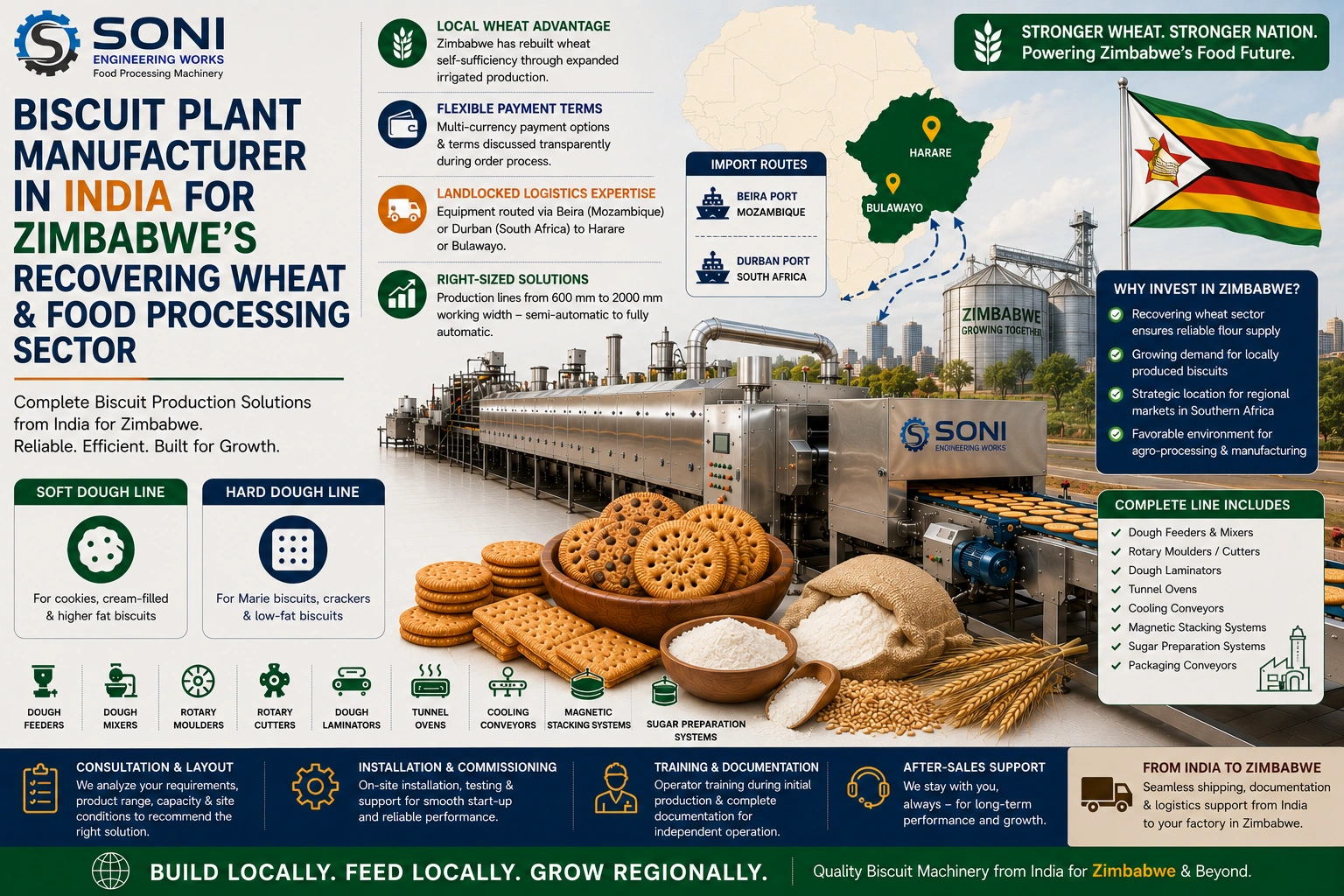
Zimbabwe has rebuilt a significant domestic wheat farming base in recent years, with government figures pointing to the country reaching wheat self-sufficiency through expanded irrigated production — a shift that matters directly to biscuit manufacturers, since flour sourced locally is more predictable than flour bought on the import market. For buyers evaluating a biscuit plant in Zimbabwe, this recovery in local grain supply is a genuine reason the timing may be right to invest in production capacity rather than continuing to rely on imported finished biscuits. Soni Engineering Works, a biscuit plant manufacturer in India, supplies biscuit production machinery and complete plant solutions to manufacturers, food-processing businesses, investors and distributors setting up or expanding operations in Zimbabwe.
Practical Considerations for Capital Equipment Purchases
Buyers in Zimbabwe evaluating imported machinery reasonably want clarity on payment currency and terms before committing to an order, given the country’s multi-currency trading environment. These details — currency of payment, deposit and delivery schedules, and documentation requirements — are addressed directly and transparently during the pre-order consultation, so there are no surprises once an order is placed. As a biscuit machine manufacturer in India, Soni Engineering Works offers production lines with working widths from 600 mm to 2000 mm, allowing a buyer to size a first plant to a capacity that matches confirmed local demand and available investment.
Soft Dough and Hard Dough Lines
Machinery selection depends on the biscuit type being produced:
- Soft Dough Lines — for higher-fat, higher-sugar biscuits such as cookies and cream-filled varieties, formed with a rotary moulder.
- Hard Dough Lines — for lower-fat, gluten-developed dough that is rolled, laminated and shaped with a rotary cutter, used for Marie-style biscuits and cracker-type products.
Soni Engineering Works reviews the buyer’s intended product range and flour sourcing plan before recommending a configuration, since dough behaviour can vary with different flour sources.
Complete Machinery and Line Components
The equipment range covers the full biscuit production sequence — dough feeders, dough mixers, rotary moulders, rotary cutters, dough laminators, tunnel ovens, cooling conveyors, magnetic stacking systems, sugar preparation systems and packaging conveyors — supplied as standalone machines for producers upgrading an existing line, or as a complete integrated plant for a new facility.
Import Logistics for a Landlocked Market
As a landlocked country, Zimbabwe typically receives imported machinery via the ports of Beira (Mozambique) or Durban (South Africa), followed by overland transport to Harare or Bulawayo. Shipment routing, documentation and realistic delivery timelines are reviewed during the pre-order consultation, alongside local power supply conditions and site readiness.
Sizing the Investment: Semi-Automatic or Automatic
Given the range of production scales seen among Zimbabwean buyers — from businesses re-entering manufacturing after a period of reduced capacity to investors starting fresh — many first-time buyers choose a semi-automatic line to keep capital investment proportionate to a developing sales base, with the option to add automation once output volumes justify it.
Installation, Training and Documentation
Every export project includes installation and commissioning, with on-site support during initial production runs to help the operating team reach consistent quality and output, plus documentation so the plant can run independently afterward.
FAQs
Does Soni Engineering Works export biscuit machinery to Zimbabwe?
Yes. As a biscuit plant manufacturer in India with international export experience, Soni Engineering Works coordinates shipping, documentation and installation for landlocked markets like Zimbabwe, typically routed via Mozambique or South Africa.
What payment currency is used for equipment orders from Zimbabwe?
Payment currency and terms are discussed and confirmed directly with each buyer during the order process, taking the local trading environment into account.
Does locally grown wheat affect which biscuit machinery I need?
Not directly — the machinery processes whatever flour is supplied. The main advantage of local wheat is more predictable sourcing and cost, which is a planning consideration rather than a machinery specification.
Is on-site installation support included for buyers in Zimbabwe?
Yes, installation and commissioning are included in every export package, with on-site support and training during initial production runs.
Discuss Your Biscuit Production Requirements
If you’re planning a biscuit manufacturing plant in Zimbabwe, talk to Soni Engineering Works about your product range, target capacity and site conditions to get a configuration suited to your market.