

-
By akashhasija20@gmail.com
-
August 26, 2026
- 0 Comment
Biscuit Machine Manufacturer in India for Kenya
Manji has been baking biscuits in Nairobi since 1954. Kenafric, Sunveat, and a handful of others round out an industry that’s already answered the hardest question a new manufacturer usually has to guess at: will this sell? It does. It has been for seventy years.
So the question isn’t whether Kenya’s biscuit market works. It’s who runs the tightest line.
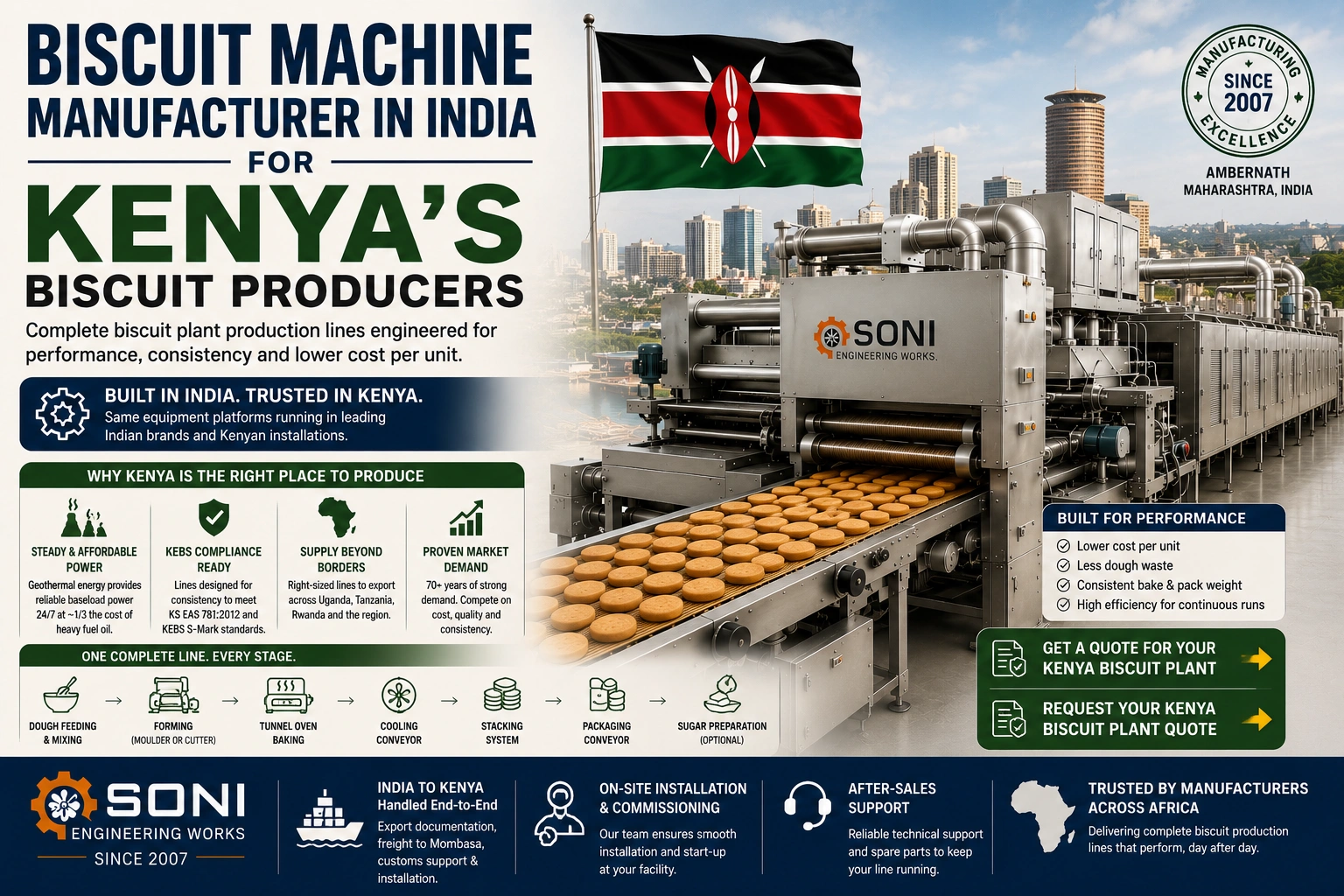
Soni Engineering Works builds that line. We’ve manufactured biscuit plant machinery out of Ambernath, Maharashtra, since 2007, and the same equipment platforms running in our Kenyan installations also run in facilities producing for premium biscuit brands back home in India.
[Get a Quote for Your Kenya Biscuit Plant →]
You’re Not Betting on Demand. -You’re Competing on Cost
Nobody has to convince Kenyan retailers that biscuits belong on the shelf. What separates the manufacturer who wins the next decade from the one who doesn’t isn’t a better story – it’s a lower cost per unit, dough that doesn’t get wasted, and pack weights that hold steady batch after batch. A poorly specified line bleeds margin quietly for years, and most owners never trace it back to the equipment. We do, because we’ve built lines that don’t bleed.
Kenya’s Grid Is Actually an Advantage – Most People Miss This
A tunnel oven hates interrupted power. Half of it goes cold, the other half keeps cooking, and you throw out a batch. Kenya doesn’t have that problem the way a lot of the region does – geothermal plants along the Rift Valley now supply a significant share of the national grid, running as steady baseload power around the clock, rain or shine. It’s also cheap: roughly a third of what heavy fuel oil generation costs per unit elsewhere. We design our ovens and conveyor systems for exactly this kind of continuous run.
KEBS Won’t Wait for You to Fix It Later
Retail biscuits in Kenya fall under KS EAS 781:2012, and shelf-ready products carry KEBS’ S-Mark. That’s a food-safety standard, not a machinery spec – but it starts failing the moment your dough weight drifts, or your bake isn’t consistent from tray to tray, and by then the batch is already made. We scope every line around the consistency KEBS inspection checks before installation.
Ambernath to Mombasa- Handled
We manage export documentation, freight through to the Port of Mombasa, and on-site installation as part of the project. One team, from quotation to commissioning.
[Request Your Kenya Biscuit Plant Quote →]
Frequently Asked Questions
Does the geothermal power situation actually matter for machine choice? Yes. Steady baseload power means a tunnel oven can run continuous cycles without the stop-start damage that comes from patchy power elsewhere in the region. We can specify for efficiency instead of building in outage tolerance you don’t need.
Can one plant supply Kenya, Uganda, Tanzania, and Rwanda? Yes, if the working width is sized for that from day one. Manufacturers already exporting from Kenya into the region built the export capacity in at the design stage. Retrofitting it later costs more than getting it right the first time.
Automatic or semi-automatic for a first plant? Semi-automatic if you’re starting out or running a specialty line – lower upfront cost. Automatic once your volume is proven and justifies the bigger investment. Many manufacturers we work with upgrade to automatic as a second phase.
Do you handle shipping and customs paperwork into Kenya? Yes. Export documentation and freight to Mombasa are part of the project. Installation support once the equipment lands.