

-
By akashhasija20@gmail.com
-
August 26, 2026
- 0 Comment
Biscuit Machine Manufacturer in India Powering Tanzania’s Fast-Growing Biscuit Market
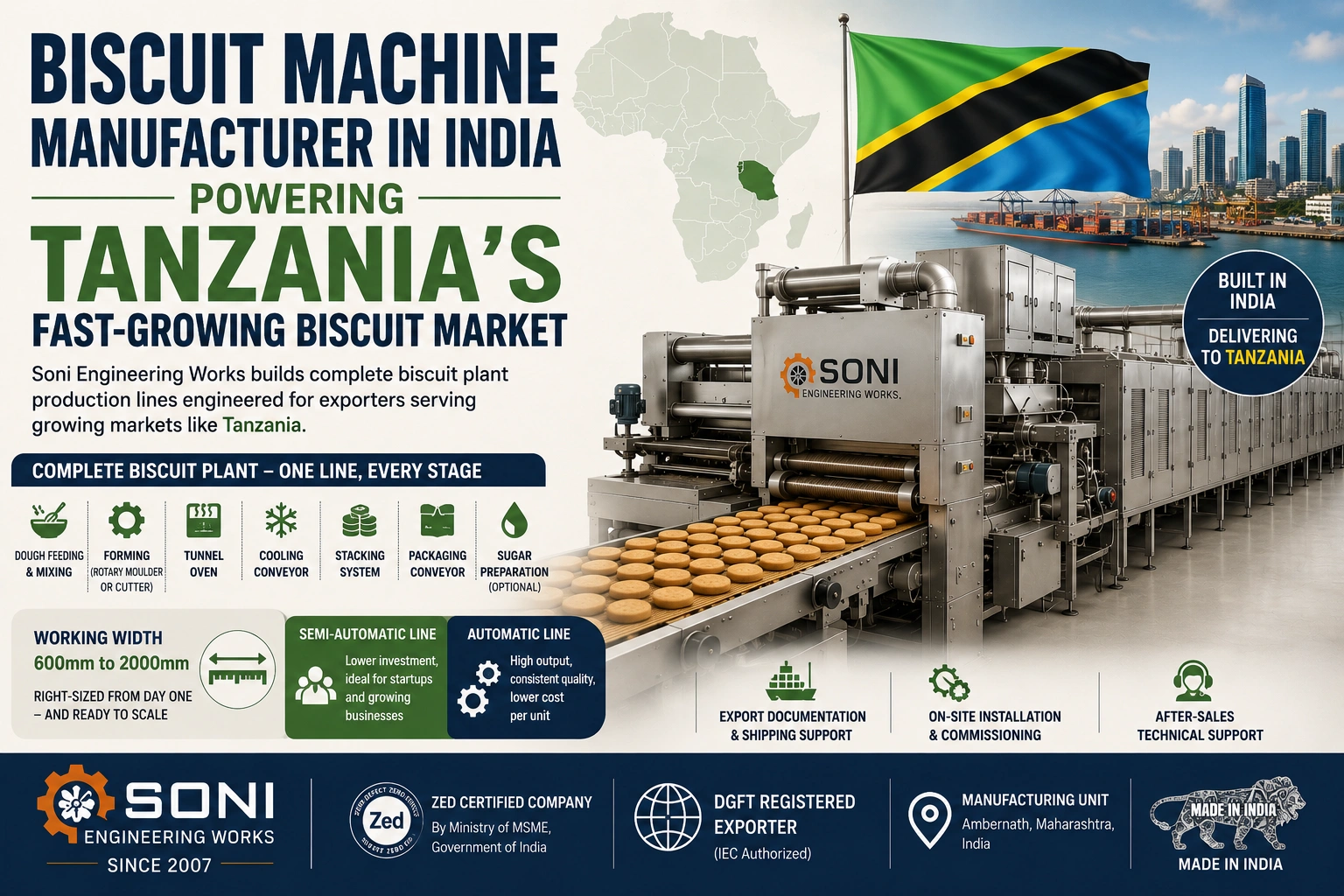
Tanzania is one of Africa’s fast-growing biscuit markets, and demand for packaged snacks keeps climbing across Dar es Salaam, Arusha, and Mwanza. For entrepreneurs and food processors looking to enter or scale up in this market, the machinery decision matters as much as the recipe. Soni Engineering Works, a biscuit machine manufacturer in India operating out of Ambernath, Maharashtra, since 2007, builds complete biscuit plant production lines engineered for exporters serving growing markets like Tanzania.
Tanzania’s Biscuit Demand Is Outpacing Local Supply
Tanzania’s biscuits and crackers segment is expected to keep growing steadily, driven by urbanization, rising disposable incomes, and a shift toward convenient, shelf-stable snacks. Local retail shelves are increasingly stocked with imported biscuits – a gap that domestic and regional manufacturers are well placed to close with the right production setup. This is exactly where a dependable biscuit plant manufacturer in India becomes a growth partner, not just an equipment vendor.
Match Your Product to the Right Forming Process
Before choosing machinery, every biscuit business must answer one question: soft dough or hard dough?
Soft dough biscuits – cookies, cream-filled varieties, and short dough formats – carry higher fat and sugar content and are shaped straight into their final form using a rotary moulder. Hard dough biscuits, such as Marie-style biscuits and cracker products, need more water and less fat so the dough develops elasticity for rolling, laminating, and cutting with a rotary cutter. Getting this choice wrong at the start creates production issues that no amount of machine tuning can fully fix later, which is why Soni Engineering’s team reviews your target product before recommending a line.
One Line, Every Stage: Dough to Dispatch
A Soni Engineering Works biscuit plant covers the entire process as one connected system rather than standalone machines: dough feeding and mixing; forming through a rotary moulder or laminator-and-cutter combination; tunnel-oven baking; cooling conveyance, stacking, and final packaging. Sugar preparation systems are also available for manufacturers producing sweetened lines at volume. Every stage is built to hand off cleanly to the next, which is what keeps a plant running at rated output instead of bottlenecking at one station.
Right-Sized From Day One – and Ready to Scale
Machine working width, from 600 mm up to 2000 mm, is what actually determines daily output. A Tanzanian manufacturer starting with a single retail line can begin with a compact semi-automatic setup and expand working width as volume grows, without redesigning the plant from scratch.
Manufacturers who have scaled their plants often note that equipment quality and installation support help them increase output while holding product quality steady. Many first-time owners find that a semi-automatic line lets them hit consistent output within budget as the business grows.
Built for Export: From Ambernath to Dar es Salaam
India is one of Tanzania’s largest trading partners, with industrial machinery among the key categories moving through the Port of Dar es Salaam. Soni Engineering Works handles export documentation, shipping coordination, and installation planning as part of the project, so a Tanzanian buyer deals with one team from quotation to commissioning instead of a chain of freight agents and customs intermediaries.
Frequently Asked Questions
Is Soni Engineering Works a manufacturer or a trading company?
Soni Engineering Works manufactures its own biscuit plant machinery in-house at its Ambernath, Maharashtra facility – it is not a reseller or trading intermediary. This is also why the same machine models supply both domestic Indian biscuit brands and international export clients.
What working width should a new Tanzanian biscuit unit choose?
It depends on daily output targets, available factory floor space, and budget. Soni Engineering’s team reviews these factors before recommending a width anywhere in the 600 mm to 2000 mm range.
Does Soni Engineering Works handle shipping and import documentation to Tanzania?
Yes. Export documentation, shipping coordination, and installation planning are managed as part of the project, so the buyer does not need to separately manage freight forwarders or customs paperwork.
Is on-site installation and after-sales technical support available in Tanzania?
Installation guidance and commissioning support are provided as standard for export orders, along with ongoing technical assistance once the plant is running.