
-
By akashhasija20@gmail.com
-
September 2, 2026
- 0 Comment
Biscuit Plant Manufacturer in India for Cameroon
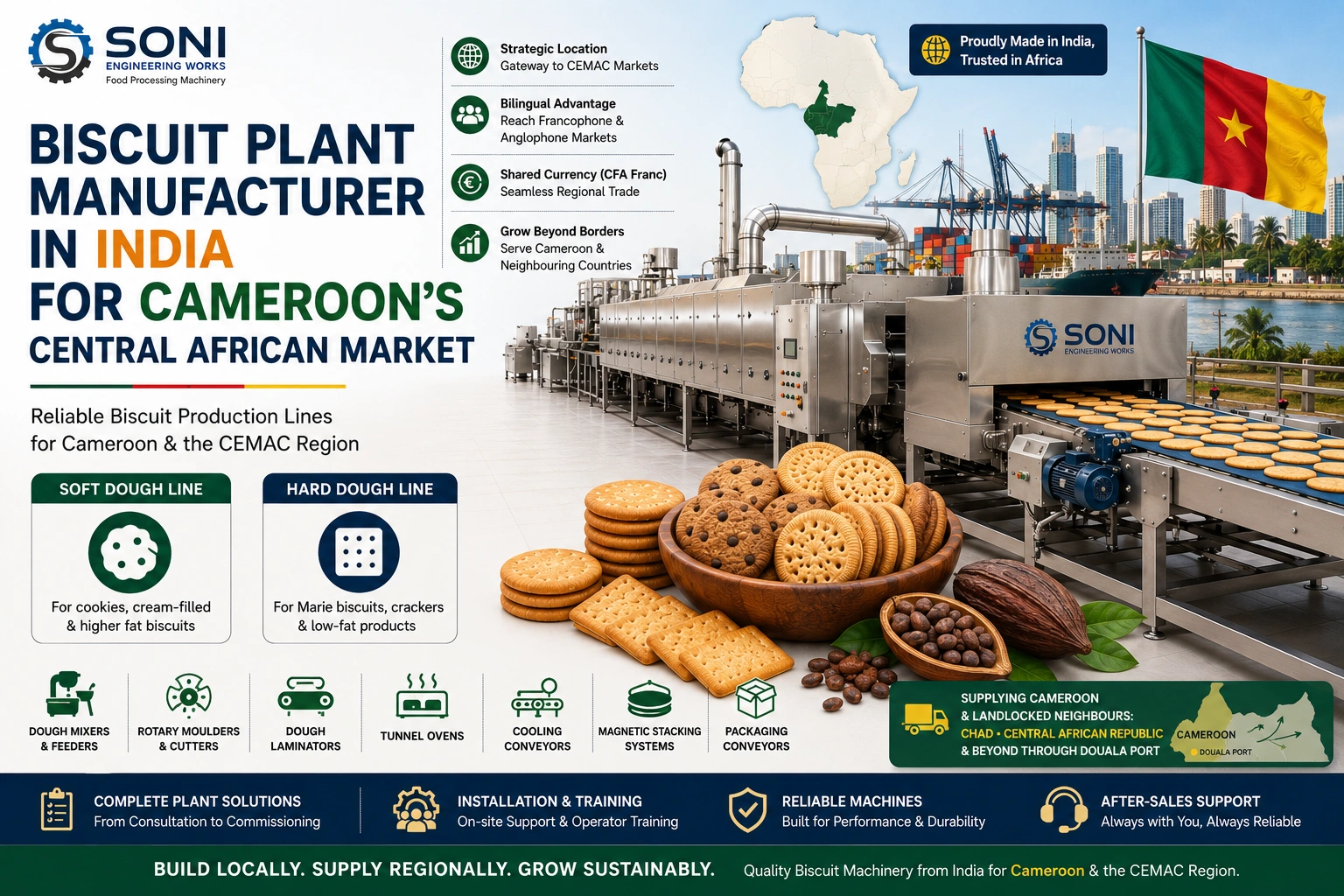
Cameroon is the largest economy in the Central African Economic and Monetary Union (CEMAC), and Douala’s port is the primary sea gateway not just for Cameroon itself but for landlocked neighbours like Chad and the Central African Republic, which route much of their imported goods through Cameroonian territory. For a biscuit manufacturer or investor based in Douala or Yaoundé, this means a production plant can be planned around more than domestic consumption alone. Soni Engineering Works, a biscuit machine manufacturer in India, supplies biscuit production machinery and complete plant solutions to manufacturers, food-processing businesses, investors and distributors setting up operations in Cameroon.
A Bilingual Market with Regional Reach
Cameroon’s position as a bilingual, English- and French-speaking country within CEMAC gives it a somewhat unusual commercial reach compared to its neighbours — a biscuit plant here can supply both Francophone and Anglophone regional markets without a language barrier limiting distribution partnerships. Combined with CEMAC’s shared currency across six Central African countries, this reduces exchange-rate complexity for buyers selling beyond Cameroon’s own borders. As a biscuit plant manufacturer in India, Soni Engineering Works offers production lines with working widths from 600 mm to 2000 mm, so a first plant can be sized to confirmed domestic and near-border demand, with room to expand capacity if wider CEMAC distribution develops.
Soft Dough and Hard Dough Lines
Machinery selection begins with the biscuit category:
- Soft Dough Lines — for higher-fat, higher-sugar products such as cookies and cream-filled biscuits, formed with a rotary moulder.
- Hard Dough Lines — for lower-fat, gluten-developed dough that is rolled, laminated and cut with a rotary cutter, used for Marie-style biscuits and cracker products.
Soni Engineering Works reviews the intended product range with each buyer before recommending a line, since the two dough types use different oven and conveyor settings and are not typically produced on a shared configuration without adjustment.
Complete Machinery and Line Components
The equipment range covers the full biscuit production sequence — dough feeders, dough mixers, rotary moulders, rotary cutters, dough laminators, tunnel ovens, cooling conveyors, magnetic stacking systems, sugar preparation systems and packaging conveyors — supplied individually for buyers upgrading an existing line, or as a complete integrated plant for a new facility.
Matching Plant Capacity to Landlocked-Market Demand
Buyers who intend to supply Chad or the Central African Republic through Douala’s overland corridor should plan capacity around confirmed distribution volumes rather than assumed regional demand, since actual uptake depends on transport logistics and buyer relationships the manufacturer arranges independently. For a first plant focused on domestic Cameroonian demand, a semi-automatic line is often the more proportionate starting investment, with automation added as output requirements grow.
Consultation, Layout and On-Site Installation Support
Before recommending equipment, Soni Engineering Works reviews production targets, raw material sourcing, local power supply conditions and the intended biscuit range with each buyer. Factory layout planning is included as part of the export process, mapping material flow from raw ingredients to packaged, dispatch-ready output. Every export project includes installation and commissioning, with on-site support during initial production runs covering operator training and quality benchmarking, plus documentation for independent operation afterward.
FAQs
Does Soni Engineering Works export biscuit machinery to Cameroon?
Yes. As a biscuit machine manufacturer in India with international export experience, Soni Engineering Works handles shipping, documentation and installation coordination for projects in Cameroon.
Can a Cameroon-based plant realistically supply Chad or the Central African Republic?
That depends on the buyer’s own distribution and transport arrangements; Soni Engineering Works’ role is to configure the production line to match whatever capacity target is confirmed.
What’s the difference between a soft dough and hard dough line?
Soft dough lines use a rotary moulder for higher-fat products like cookies; hard dough lines use rolling, laminating and a rotary cutter for products like Marie biscuits.
Is on-site installation support included for buyers in Cameroon?
Yes, installation and commissioning are included in every export package, and equipment is shipped only once the site is confirmed ready.
Discuss Your Biscuit Production Requirements
If you’re planning a biscuit manufacturing plant in Cameroon, talk to Soni Engineering Works about your product range, target capacity and site conditions to get a configuration suited to your market.