

-
By akashhasija20@gmail.com
-
August 26, 2026
- 0 Comment
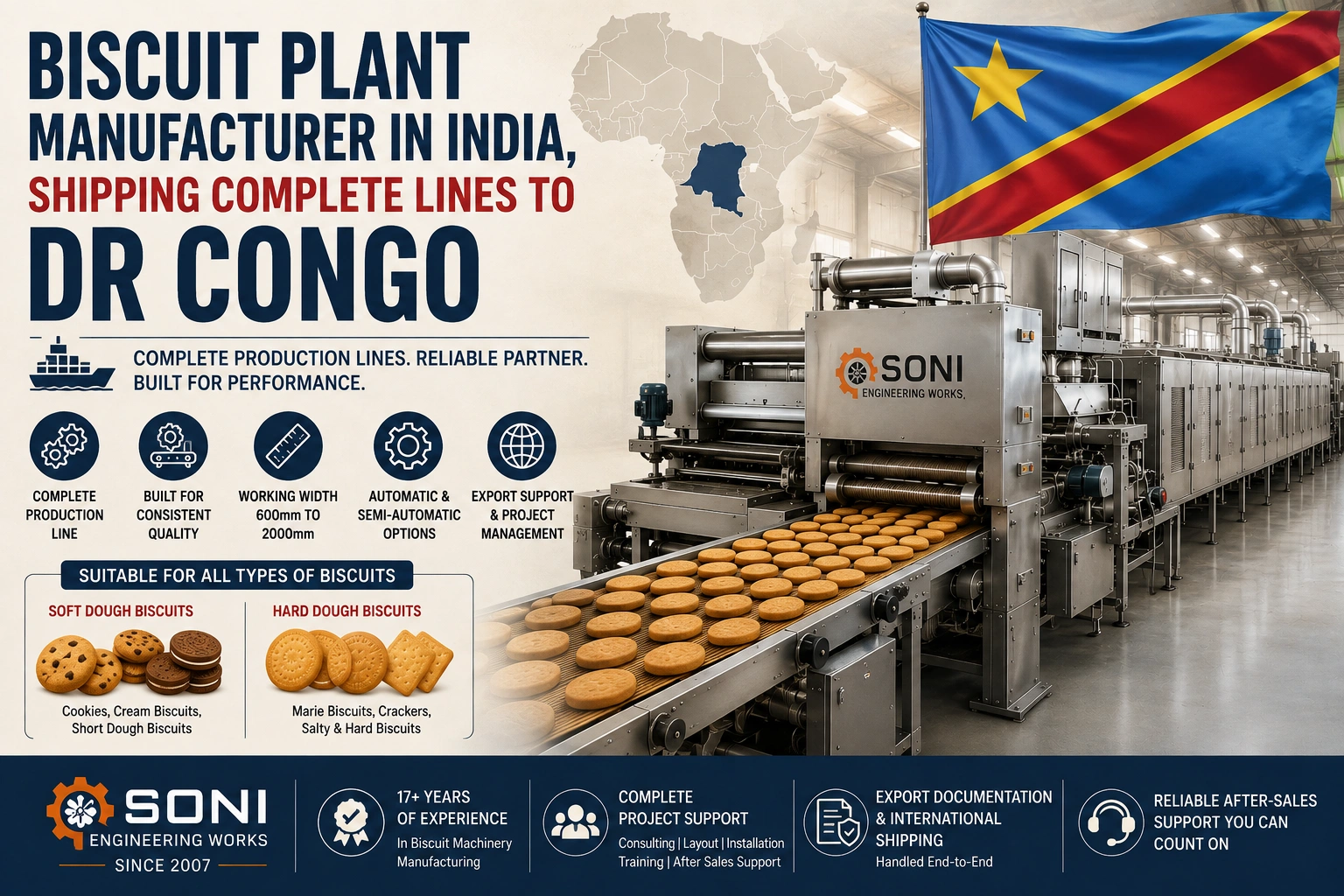
Biscuit Plant Manufacturer in India for DR Congo
You’ve done the market research. Packaged biscuits are moving off small local stalls and onto proper retail shelves in Kinshasa, Lubumbashi, and beyond. Now comes the part that actually decides whether this works: the machinery. We’re Soni Engineering Works, a biscuit machine manufacturer in India, building complete production lines since 2007.
Walk the Line With Us
Every plant we build starts with a dough feeder that keeps your mixer fed at a steady rate: no manual dumping, no inconsistent batches.
From there, the dough goes through mixing, then into forming, either a rotary moulder or a rotary cutter, depending on what you’re making.
If your product needs lamination, that stage sits before forming, rolling, and folding the dough until it’s ready to cut.
Next is the tunnel oven, where your biscuits actually become biscuits. After baking, a cooling conveyor brings the temperature down gradually so the biscuits don’t crack or sweat inside their packaging later.
A magnetic stacking system lines them up, and a packaging conveyor carries them into final wrap. If your product needs a sugar coating or glaze, we build that stage in too, through a dedicated sugar preparation system.
That’s the whole line: one supplier, one point of contact, and every stage built to talk to the one before and after it.
Sizing the Plant to Your Market Entry
We build working widths from 600 mm up to 2000 mm. A narrower line costs less to install and gets you producing sooner, which matters if you’re entering the DR Congo market for the first time and want to prove demand before committing more capital. A wider line makes sense once you already know your volume and you’re building for a commercial-scale operation from day one. There’s no universal right answer here. It comes down to these things: how many biscuits you need per day, how much floor space your site has, and how fast you plan to grow past your opening numbers.
Automatic Doesn’t Always Mean Better
A lot of buyers assume automatic is the goal and semi-automatic is the compromise. That’s not quite right. Semi-automatic lines give you tighter control over specialty or premium products at lower volumes, and they cost less to get running, which suits a manufacturer still finding its footing in a new market. Automatic lines earn their keep once your daily output climbs high enough that manual handling becomes the bottleneck, not the machinery. We’ll tell you honestly which one your numbers support.
What Happens After You Reach Out
You tell us your biscuit type, your target daily output, and your floor space. We come back with a configuration built around those three numbers, not a catalog page with a quote attached. From there, we handle the trade documentation and coordinate the full international project ourselves, consulting, layout design, and manpower planning included.
Frequently Asked Questions
What machines are actually included when I buy a complete biscuit production line from you? Dough feeder, mixer, forming stage (rotary moulder or rotary cutter, depending on your product), laminator (if your process needs it), tunnel oven, cooling conveyor, magnetic stacker, and packaging conveyor. If your product needs a sugar coating, we add a dedicated sugar preparation system to the line.
How do I know what working width I need for a new plant in DR Congo? Start with your target daily output and your available floor space. A 600 mm line costs less and gets you into production faster, which suits a first-time market entry. Widths up to 2000 mm support commercial-scale volume once you know your numbers. We’ll help you land on the appropriate figure.
What’s the real difference between automatic and semi-automatic on the factory floor? Semi-automatic lines need more manual handling at certain stages, which keeps your upfront cost down and gives you tighter control at lower volumes. Automatic lines minimize manual intervention across the line, which pays off once your output is high enough that labor becomes your limiting factor rather than the machines.
Start the Conversation
Request your biscuit plant configuration today.